Pinocchio Returns to the Fairy’s House and Is Promised He Can Become a Real Boy
Pinocchio (Tania Zamorsky Edition)Pinocchio’s return to the Blue-Haired Fairy’s House turns a narrow escape into a renewed chance at transformation. Rescued from the Green Fisherman by Alidoro, he reaches the Fairy again in a state of fear and material need. Her forgiveness gives him another opportunity, but the promise of becoming a real boy is not immediate: it follows a year in which he keeps his word, studies, and earns praise at school. The episode makes the promised change depend on sustained conduct rather than on rescue alone.
Rescue and the Road Back
The return begins with Alidoro carrying Pinocchio out of immediate danger. The Green Fisherman had coated him from head to foot in flour and was about to put him in a frying pan when Alidoro, drawn to the smell of the food, snatched him up and ran from the grotto. Once the dog found the path to the village, he gently set Pinocchio down. Pinocchio thanked him, but Alidoro presented the rescue as repayment: Pinocchio had saved him earlier, and now he had returned the favor. Their parting handshake gives the escape a distinctly reciprocal meaning; Pinocchio is not only a victim being saved but also someone whose earlier action has created a bond of mutual aid.
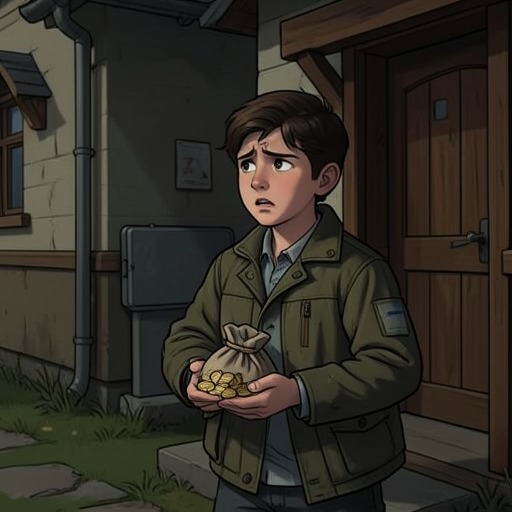
After Alidoro leaves, Pinocchio seeks news of Eugenio, the schoolboy wounded in the earlier trouble. A nearby old man tells him that fishermen have carried the injured boy to the hut. Pinocchio then asks for something to wear so he can return home. The old man has no clothes to offer, only an empty sack that had held lupins. Pinocchio cuts a small opening in its bottom and two at the sides, and wears it like a shirt. This makeshift garment is a concrete sign of how exposed and diminished he is as he sets out: the path home is a return in intention before it is a comfortable or confident homecoming.
A Hesitant Approach to the Fairy’s House
On the road, Pinocchio worries that the Blue-Haired Fairy may not forgive this latest piece of mischief. He recognizes the pattern in his own conduct: he repeatedly promises to reform and then fails to keep those promises. The self-reproach does not spare him the difficult approach. He reaches the village after dark in heavy rain and heads directly to the Blue-Haired Fairy’s House, resolved to ask to be let in, but loses his nerve at the door.
His hesitation becomes a small, measured ordeal. He retreats about twenty paces, comes back, and retreats again; only on his fourth approach does he take hold of the iron knocker and tap lightly. After waiting half an hour, he sees a window open on the top floor of the four-story house. A large snail appears there with a small light burning on its head. The delay and repeated retreats give physical form to his fear of rejection. Although the supplied scene does not establish the outcome of this first encounter at the window, Pinocchio eventually returns to the Fairy’s care: when he recovers from a faint, he finds himself lying on a sofa with her beside him.
Forgiveness and a Conditional Promise
The Fairy forgives Pinocchio once more, while making clear that another offense would bring a different response. Her forgiveness is not presented as the erasure of what has happened. Instead, it creates a renewed obligation. Pinocchio promises and swears that he will study and behave well; this time, the narrative records not merely the promise but its fulfillment over the remainder of the year.
At the vacation examinations, Pinocchio has the honor of being the best student in the school. His conduct, too, is judged generally praiseworthy and satisfactory. These details make the Fairy’s offer a consequence of observable change: the return from danger leads to a period of effort, and that effort gives substance to the desire he has long expressed. She tells him that the next day his wish will finally be granted. When he asks what that means, she specifies the change: he will stop being a wooden puppet and become a proper boy. The promise is definite, but the transformation has not yet occurred within this episode.
The Planned Celebration and Its Uncertain Future
The news fills Pinocchio with a joy the narrator says cannot be imagined by anyone who has not seen it. The Fairy plans to invite all his friends and schoolmates to a great breakfast at her house in celebration. Its scale is made precise: two hundred cups of coffee and milk and four hundred rolls, buttered on both sides. After the danger, the improvised lupin-sack shirt, and the anxious wait at the door, this abundance marks a striking change in what awaits him: not another escape, but a communal celebration of his anticipated new status.
Yet the promised change remains poised in the future. The announcement of the breakfast is immediately qualified by the narrator’s observation that, in the lives of puppets, there is always a but that spoils things. The passage therefore closes not with Pinocchio already transformed, but with the transformation promised and a celebration prepared, while hinting that the expected ending may be interrupted. That distinction matters: his year of good conduct has earned the Fairy’s confidence and the promise of becoming a boy, but the narrative has not yet shown the promise fulfilled.